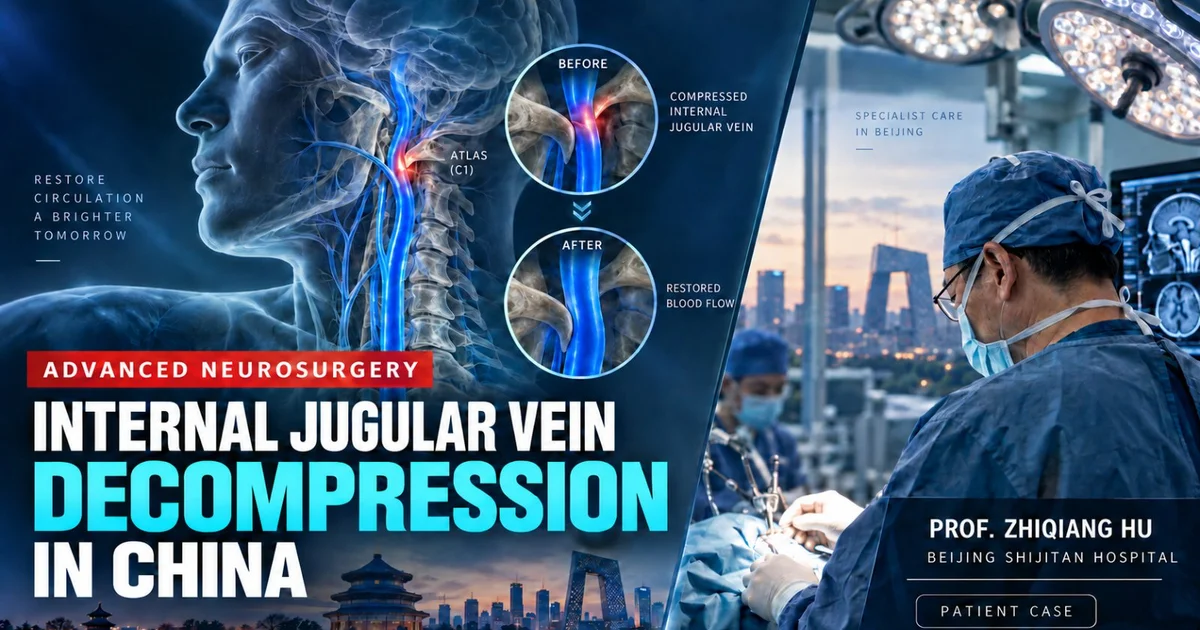
Internal jugular vein stenosis can restrict venous drainage from the brain. In a carefully selected group of patients, the narrowing is caused by external compression near the upper cervical spine, commonly between the styloid process and the transverse process of the first cervical vertebra, or atlas. Beijing Shijitan Hospital has developed a specialist programme to evaluate these cases and, when the evidence supports it, perform microsurgical decompression.
The programme is led by Professor Zhiqiang Hu and the hospital's neurosurgical team. Professor Hu has personally confirmed that the team has now completed more than 1,000 internal jugular vein decompression procedures. This is the team's latest cumulative surgical volume as of 2026; earlier articles and individual research papers naturally report smaller numbers because they cover earlier periods or defined study groups.
This guide explains what the operation is, who may be considered, what testing is needed, and what international patients should realistically expect. It is not a promise that surgery will help every patient.
A note on who we are: China MedPass is an independent, Beijing-based medical coordination service. We are not a hospital and do not make clinical decisions. We help international patients prepare records, reach the appropriate hospital team, communicate across languages and manage the practical process. Diagnosis and treatment decisions rest with the treating specialists.
What is compressive internal jugular vein stenosis?
The internal jugular veins are major pathways carrying venous blood away from the brain. A narrowing may be caused by a problem inside the vein, by surrounding soft tissue, or by external bony compression. The operation discussed here is intended for selected cases in which imaging and haemodynamic assessment show clinically meaningful external compression.
Symptoms reported in patients with impaired cranial venous outflow can include persistent head noise, pulsatile or non-pulsatile tinnitus, headache, head pressure, dizziness, sleep disturbance, blurred vision, hearing changes, neck discomfort and cognitive complaints. These symptoms are non-specific. They can also be caused by ear disorders, migraine, intracranial pressure disorders, vascular disease, cervical conditions, medication effects, anxiety and many other problems.
A narrowed vein on a scan does not by itself prove that the narrowing is causing the patient's symptoms. A proper assessment must connect the symptoms, physical findings, anatomy, collateral circulation and blood-flow measurements before surgery is considered.
What does the operation involve?
Where the upper internal jugular vein is compressed by the atlas transverse process or nearby structures, the surgical goal is to create more space around the vein. Depending on the individual anatomy, the procedure may include partial removal or drilling of the compressing bone, release of restrictive soft tissue, and careful restoration of the vein's surrounding space.
The exact operation is not identical for every patient. Some patients have a predominantly bony compression pattern; others have combined bony and soft-tissue compression, previous venous stenting, bilateral disease or another anatomical configuration. The surgical plan therefore has to be based on the original imaging rather than on symptoms alone.
According to the surgical team, the operation is commonly performed through a small neck incision of approximately 2-3 cm in suitable cases. Incision length, operating time and the extent of decompression vary with anatomy, laterality, previous procedures and intraoperative findings.
Why is this programme notable?
Professor Hu's academic work includes the development of evaluation criteria, diagnostic standards, surgical indications and operative standards for internal jugular vein stenosis associated with what the team describes as brain-noise syndrome. The Beijing Shijitan Hospital team has also published clinical research on CT venography, atlas transverse process decompression and symptom outcomes.
Published research supports the possibility that removing an external bony compression can improve venous calibre and symptoms in selected patients. However, the evidence base is still developing. Existing studies are mainly retrospective cohorts and case series rather than large randomised trials. The team's growing surgical volume is important clinical experience, but it does not remove the need for careful patient selection or longer-term research.
Who may be considered for surgery?
A specialist may consider surgical decompression when several factors point in the same direction:
- Persistent and significant symptoms despite appropriate evaluation and conservative treatment
- Clear focal compression of the internal jugular vein on appropriate venous imaging
- An anatomical pattern that can reasonably be corrected by decompression
- Evidence that the stenosis affects venous drainage, rather than being an incidental scan finding
- Symptoms and side of disease that are clinically consistent with the imaging
- No safer or more appropriate explanation and treatment pathway
- Acceptable anaesthetic and surgical risk after preoperative assessment
Patients should not assume that tinnitus, headache or cognitive symptoms automatically indicate jugular vein surgery. Many people with these complaints will not be surgical candidates.
What tests are usually required?
The team normally needs the original DICOM images, not only written radiology reports. The assessment may include:
- CT venography of the head and neck with three-dimensional reconstruction
- MR venography or other brain and venous MRI sequences
- Jugular venous ultrasound with flow assessment
- Review of the styloid process, atlas transverse process and jugular foramen anatomy
- Assessment of collateral venous pathways and whether the narrowing is unilateral or bilateral
- Neurological, neurosurgical and, where appropriate, ear, nose and throat or ophthalmological assessment
- Additional pressure or haemodynamic testing in selected complex cases
If a patient's existing imaging does not use the necessary protocol, the specialist may recommend repeat imaging in Beijing before making a final decision.
Results and recovery: what is realistic?
The team's current experience now extends to more than 1,000 operations. Professor Hu reports generally favourable recovery and clinical improvement among appropriately selected patients. Earlier published data provide useful historical context: a 2025 Health Times report quoted Professor Hu as saying that, among 150 patients reviewed by the team at that stage, the overall reported response rate had risen to more than 70%. The current 1,000-plus figure is the team's later cumulative surgical volume, not the sample size of that earlier analysis.
That also means a meaningful minority did not have the hoped-for response. Improvement may be immediate, gradual or incomplete. Long-standing compression may leave a vein slow to re-expand even after the surrounding pressure is removed. Different symptoms may respond differently, and radiological improvement does not guarantee that every symptom will disappear.
According to the team, the small incision and focused decompression allow many patients to recover well, but recovery depends on the exact operation and the individual. Patients still need monitoring for pain, wound healing, swallowing or voice symptoms, neurological changes and venous complications. The treating surgeon determines the hospital stay, activity restrictions, follow-up imaging and timing of travel.
How much does the surgery cost?
As a recent real-world reference, an American patient coordinated by China MedPass paid approximately RMB 50,000 in hospital charges for the operation and admission while staying in a private single room in the hospital's special medical services ward. The procedure was completed successfully and the patient's early recovery was good.
This is an actual patient example, not a fixed package price or guarantee. The final hospital bill can change according to the required preoperative examinations, whether treatment is unilateral or bilateral, the precise surgical approach, length of stay, room category, medicines, consumables and any additional care. International flights, accommodation outside the hospital and China MedPass coordination services are separate unless expressly included in a written quotation.
For planning purposes, China MedPass can request an individual estimate after Professor Hu's team has reviewed the patient's medical history and original DICOM imaging.
Potential risks and limitations
This is surgery in a complex upper-neck region containing major veins, arteries and cranial nerves. Potential risks may include bleeding, injury to the internal jugular vein or nearby nerves, haematoma, infection, thrombosis, persistent pain, voice or swallowing changes, incomplete decompression, restenosis and failure to improve the original symptoms. The individual risk profile may be different in patients with previous surgery or venous stents.
The specialist should explain the proposed approach, alternatives, material risks and expected recovery after reviewing the patient's own anatomy. No reputable service should promise a cure before this review.
Professor Zhiqiang Hu and Beijing Shijitan Hospital
Professor Zhiqiang Hu is a senior neurosurgeon and academic supervisor at Capital Medical University-affiliated Beijing Shijitan Hospital. His listed research directions include minimally invasive neuroendoscopic surgery and the evaluation, diagnosis, surgical indications and operative standards for internal jugular vein stenosis-associated brain-noise syndrome.
His team has collaborated with specialists in cerebral venous disease and has contributed to Chinese and international publications on jugular venous decompression. The programme has also been used to train other neurosurgical teams in standardised assessment and surgery.
How an international patient can request a review
The safest first step is usually a remote case review before booking travel. China MedPass can organise the patient's records in Chinese, transfer the original imaging for review, coordinate hospital registration and arrange a remote or in-person specialist consultation where available.
For an initial review, patients should prepare:
- A passport information page for hospital registration
- A concise symptom history and timeline
- Original CT, MRI, CTV or MRV DICOM files
- Radiology reports and previous specialist opinions
- Details of treatments already tried, including any venous stent or neck surgery
- Current medicines, allergies and major medical conditions
- A list of the questions the patient wants the surgeon to answer
After reviewing the case, the specialist can advise whether the findings justify further testing, conservative management, endovascular assessment or surgical decompression, and whether travelling to Beijing is worthwhile.
Key questions to ask before deciding
- Is the stenosis genuinely responsible for my symptoms or could it be incidental?
- What structure is compressing the vein?
- Is the disease unilateral or bilateral, and which side should be treated?
- What objective improvement is expected in venous drainage?
- Which of my symptoms are most and least likely to improve?
- What are the alternatives to surgery?
- What are the surgeon's complication, reoperation and non-response rates for patients like me?
- How long should I remain in Beijing before flying home?
Frequently asked questions
Does a narrowed internal jugular vein always require surgery?
No. A narrowed vein can be an incidental imaging finding. Surgery is considered only when the specialist finds a convincing relationship between the patient's symptoms, anatomy and impaired venous drainage.
How large is the incision?
Professor Hu's team advises that the neck incision is commonly about 2-3 cm in suitable cases. The actual incision and surgical extent depend on the patient's anatomy and planned approach.
How many procedures has the team performed?
Professor Hu has personally stated that his team has completed more than 1,000 internal jugular vein decompression procedures as of 2026. Earlier publications may show smaller figures because they describe earlier periods or specific study cohorts.
How much might treatment cost?
One recent American patient coordinated by China MedPass paid approximately RMB 50,000 in hospital charges while using a private single room in the special medical services ward. This is a real case reference, not a fixed quotation; the hospital must estimate each patient's costs individually.
Should an international patient travel to Beijing before review?
Usually, the practical first step is to send the medical history and original DICOM imaging for specialist review. The doctor can then advise whether additional testing or travel to Beijing is worthwhile.
Evidence and sources
- Ma H et al. Isolated surgical decompression for compressive internal jugular vein stenosis. Frontiers in Surgery, 2025.
- Lu S et al. Effectiveness of Atlas Transverse Process Resection Combined With Release and Perfusion Techniques. World Neurosurgery, 2025.
- Health Times report on the Beijing Shijitan Hospital programme and outcomes reported by Professor Hu, 2025.
- Capital Medical University profile of Professor Zhiqiang Hu and his listed research directions.
China MedPass is an independent medical coordination service and does not diagnose, recommend surgery or guarantee results. The information above is educational. Eligibility, treatment and expected outcomes must be determined by the treating hospital and specialist after review of the patient's complete records and imaging. The 1,000-plus procedure figure was communicated directly by Professor Hu; the RMB 50,000 cost is one recent patient example and is not a hospital quotation.