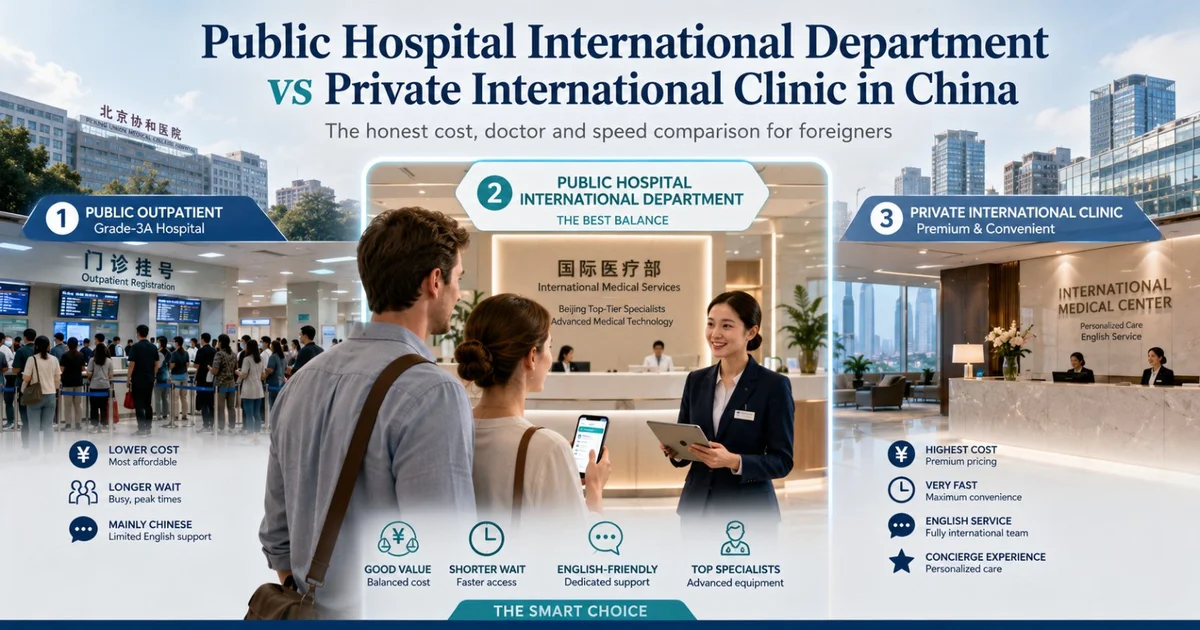
If you live in China as a foreigner, you've probably had this conversation: someone swears the only safe place to get medical care is an expensive private international clinic, while someone else insists the best doctors in the country are in the big public hospitals — if only you could figure out how to use them. Both can be right, and the gap between them is where a lot of people quietly overpay for years.
This guide lays out the honest differences between a public Grade-3A hospital's international department and a private international clinic — on cost, on doctors, on speed — and names the real reason most foreigners stick with private care even when it costs far more.
A note on who we are: China MedPass is an independent, Beijing-based medical coordination service. We're not a hospital and not your doctor — we help with the system, the language and the logistics. Clinical decisions rest with the treating doctors.
Three settings, not two
It helps to think in three tiers, not a simple public-versus-private split:
- Regular public outpatient — the cheapest by far (registration often ¥20–500), staffed by the same senior specialists, but a fast-paced, crowded, Chinese-language environment with a "pay at each step" process.
- Public hospital international / VIP department — the same top public-hospital specialists, but with English-speaking staff, far shorter waits, more face-time, single rooms and a smoother process. More expensive than ordinary outpatient (registration often ¥500–2,000), but still well below private.
- Private international clinic or hospital — English by default, Western-style service, direct insurance billing — and the highest prices (a GP visit can run ¥620–1,530+, a specialist more).
The doctors: often the same people
This is the part many foreigners don't realise. In China, the strongest specialists, the most advanced equipment and the highest case volumes are concentrated in the big public "Grade-3A" (三甲) hospitals, not in private clinics. Private clinics are excellent at service and convenience, but for deep specialist expertise they frequently bring in — on a contract basis — the very same senior doctors who work at the public hospitals.
In other words, for a complex or specialist problem, going private can mean paying a premium to see, through a nicer waiting room, a specialist you could often see directly at the public hospital for a fraction of the price.
The cost gap is real
The savings aren't marginal. A simple example reported by foreign patients: a chest-pain work-up (registration, ECG, X-ray, blood panel) at a public hospital might total roughly ¥500–900, while the same work-up at a private international clinic can be ¥3,000–6,000 — several times more. Consultations show the same pattern: tens to a few hundred RMB in public ordinary outpatient, versus four figures in private.
The public international department sits in between: more than ordinary outpatient, much less than private — which is why, for many people, it's the sweet spot.
The speed that surprises people
For patients used to long Western waiting lists, the pace can be startling. In a top public hospital you can often book a specialist, have an MRI or CT, and get the results within the same day — no months-long wait, no referral chain. Through the international department this is smoother still: shorter queues, and results the specialist can pull up on screen, frequently without you having to re-register to be seen again.
So why do so many foreigners still overpay?
Here's the honest answer, and it's not about quality. It's three practical barriers:
- The apps. Registration, payment and results increasingly run through Chinese-only apps and WeChat mini-programs. Top specialist slots can be released two weeks ahead and disappear in minutes. If you can't read or work the app, you're locked out of the best slots.
- The language. Day-to-day Chinese is one thing; discussing a diagnosis, a surgical risk or an administrative form is another level entirely. Many people manage daily life fine but hit a wall the moment the conversation turns medical.
- The system. The "register, pay, test, pay, see doctor again" flow, the department you have to choose yourself, the lack of a nurse triage or automatic follow-up — none of it is hard once you know it, but it's bewildering the first time.
That's the real reason people default to private care: not because the medicine is better, but because private clinics remove the friction. Pay enough and the language and logistics disappear. The trouble is, you're paying a large premium for what is, at bottom, a navigation problem.
The international department: the middle path
For many foreign patients — especially for anything serious or specialist — the public hospital's international department is the best balance: the top public-hospital expertise and equipment, with English support, shorter waits, more privacy and a manageable process, at a fraction of private prices. It's particularly strong when several departments need to work together on a complex case, which is exactly where private clinics are weakest.
A few honest caveats: international-department slots still need to be booked (often ~15 days ahead) and can require persistence; you'll usually pay as you go and keep your receipts (the 发票/fāpiào for insurance claims); and most public hospital cashiers take WeChat Pay or Alipay rather than foreign cards. If you'd prefer a fully Western, direct-billing experience for routine family care, a private clinic may still suit you better — it's a genuine trade-off, not a one-size-fits-all answer.
Where we fit in
What we do is remove the three barriers without the private-clinic price tag. We're Beijing-based and we know the system: we handle the registration and the apps, secure international-department slots with the right senior specialist, prepare and translate your case in advance, interpret in person, and give you a faithful written English summary of everything the doctor says. You get the top public specialist, in English, without being "dead in the water" on the tech and language.
If you'd like, see our specialist second opinion service, our transparent pricing, and our guides to leading Beijing hospitals.
Frequently asked questions
Are public hospital doctors in China good?
The strongest specialists, highest case volumes and most advanced equipment are concentrated in the big public Grade-3A hospitals. For complex or specialist care, they are usually the strongest option in the country.
What is the international department?
A wing inside a public hospital offering the same specialists with English-speaking staff, shorter waits, more privacy and a smoother process — priced above ordinary outpatient but well below private international clinics.
Is it much cheaper than a private clinic?
Usually yes. The same work-up can cost several times less than at a private international clinic, while giving you access to the same — or more experienced — specialists.
Do I need to speak Chinese?
In the international department, staff often speak English. The harder parts are the booking apps and detailed medical conversations — which is exactly what a coordinator helps with.
Can I pay with a foreign card?
Most public hospital cashiers take WeChat Pay or Alipay (which can be linked to a foreign card) rather than swiping a foreign card directly. Always ask in advance.
China MedPass is an independent medical coordination service. We help with registration, translation, appointments and on-site support; we do not provide diagnosis or treatment, we cannot guarantee outcomes, and all clinical decisions rest with the treating hospital specialists. Costs above are approximate ranges from public sources for general guidance, not quotes.